
19 and 1 Trams: The Other Inner North
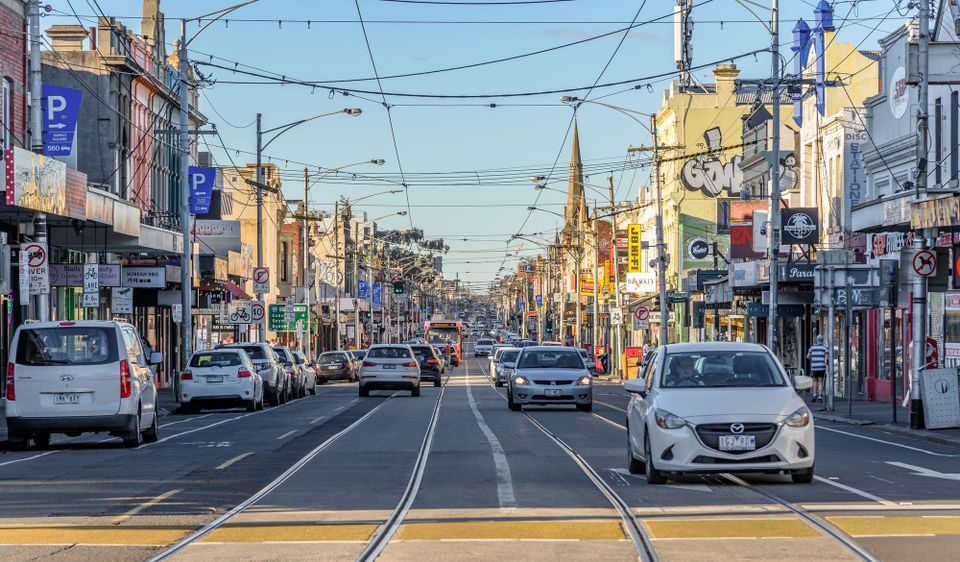
The 86 tram gets the mythology. But if you want to understand what Melbourne's inner north actually runs on, what it was built from, what it keeps returning to, then ride the 19 up Elizabeth Street and Sydney Road, or follow the 1 through Carlton and out along Royal Parade. These routes are older, quieter and less self-conscious, covering the half of the inner north that has been doing the same things for much longer than the suburb-to-suburb lifestyle conversation would suggest.
Both trams reach Brunswick. Both terminate in Coburg. Together they trace a corridor that was multicultural before Melbourne used the word, that built its food culture from postwar migration wave by wave, and that retains a texture of everyday life — markets, bakeries, music pubs, community gardens — that newer inner-north arrivals are still discovering.
The 1 takes the academic path: up Swanston Street, through Carlton and its university belt, past the bookshops and old trattorias on Lygon Street, then north along Royal Parade to East Coburg. The 19 takes the western line: up Elizabeth Street, through North Melbourne, then straight up Sydney Road — one of the world's great multicultural strips — through Brunswick and all the way to North Coburg.
Three suburbs. Less mythology than the 86 corridor, and considerably more depth.
Carlton
The Long Lunch End of the Inner North
Carlton built Melbourne's idea of what a restaurant street looks like. Postwar migrants from Italy, arriving through the 1950s and 1960s, opened trattorias, pasticcerie and delis along Lygon Street that turned an unremarkable terrace strip into a landmark — not by designing an experience, but by serving the food they knew, for decades, until a suburb formed around it.
That story is still visible and still eating. Tiamo still serves the same pasta. Brunetti still draws a Saturday morning crowd that spills onto the footpath. But Carlton was never only a place to eat. The University of Melbourne sits at its western edge, spilling students and academics into the surrounding streets and funding a café culture that goes deeper than most. La Mama Theatre, which opened on Faraday Street in 1967, became the incubator for an entire generation of Australian playwrights — Jack Hibberd, David Williamson, Barry Dickins — who put Australian voice and working-class experience on stage at a time when the professional theatre wasn't interested. It is still running, still taking the same kinds of risks. Readings on Lygon is among Australia's finest independent bookshops. Cinema Nova has been Melbourne's essential arthouse cinema for more than three decades.
Carlton suits people who read, eat and argue. It suits the long Sunday afternoon that starts in a bookshop and ends in a restaurant, the weeknight theatre dash, the slow lunch that quietly becomes dinner without anyone noticing. It's more intellectually inclined and less nocturnal than Collingwood, and it carries a different kind of confidence — the kind that comes from being genuinely good at one thing for a very long time.
Eat
- Long lunches and honest pasta at Tiamo on Lygon Street, one of the corridor's most enduring Italian institutions, still serve the same reliable plates in the same unhurried way it has for over fifty years.
- Italian deli plates, cheese and wood-fired pizza at D.O.C. — the group's original Carlton venue sits on Drummond Street and remains one of the most consistent places in the inner north for the kind of simple, quality eating that needs no explanation.
- Pastry, espresso and standing-room buzz at Brunetti Classico on Lygon, where the pastry cabinet and the noise and the complete lack of ceremony are inseparable from the experience.
Drink
- Wine from a serious, well-considered list at Jimmy Watson's, the Lygon Street institution that has been doing this since 1935 and remains the corridor's most venerable drinking address.
- Natural wine in a neighbourhood setting at Heartattack and Vine, Carlton's contribution to the inner-north wine bar scene that now stretches the length of the corridor.
- Easy pints at The Lincoln on Cardigan Street — the kind of dependable neighbourhood pub Carlton needs as ballast against its more earnest tendencies.
Do
- Spend an afternoon at Readings on Lygon Street, where the stock, the curation and the staff recommendations make it genuinely easy to spend more time and money than planned.
- Watch a film at Cinema Nova — for arthouse releases, restored classics and the kind of audience that reads the credits.
- Take in a show at La Mama Theatre on Faraday Street, the tiny fringe venue that has mattered more to Australian theatre than almost anything bigger or better funded, and that continues to give space to new work with no apology.
Brunswick
Sydney Road Never Really Changes
Sydney Road is one of the world's great strips. It runs from Royal Parade to Bell Street and beyond, changing character in small increments — Middle Eastern bakeries, African grocers, natural wine bars, Vietnamese takeaways, vintage shops, Lebanese sweets, record stores — without ever quite becoming something else. It has been this way for thirty years. The names above the doors change; the density and the energy don't.
Brunswick is the suburb Sydney Road belongs to. It has long housed Melbourne's musicians, its artists and its new arrivals in roughly equal measure, and where the two cultures have always been more comfortable with each other than the gentrification narrative suggests. The suburb's music identity is genuine and earned: the Retreat Hotel has programmed live music seven nights a week for years, making it one of the most important live venues in the city by sheer consistency. The suburb's concentration of cheap rehearsal studios and share houses means the bands that play the Northcote Social Club and The Tote mostly live and write here, two suburbs south of where they perform.
Brunswick also has one of the inner north's most honest everyday food cultures, built from multiple directions at once: Syrian and Lebanese restaurants with decades of accumulated knowledge, a strong Israeli café scene, long-standing Italian legacy, and newer openings that sit comfortably beside all of it without explaining themselves. The Sydney Road Street Party, which closes the strip to traffic each February for a full day of live music across outdoor stages, is the clearest expression of what the corridor is at its most confident: local, loud, completely unironic.
People choose Brunswick because it is still genuinely mixed. The cool quotient has risen over the past decade but the suburb has absorbed the change without fully becoming curated. You can eat Lebanese pastry and drink natural wine on the same block and feel, correctly, that this has always been the point.
Eat
- Persian and Lebanese cooking in a warm, genuinely unhurried room at Rumi — one of the inner north's most-loved restaurants, where slow-cooked meats, exceptional dips and warm bread reward people who aren't in a rush.
- Specialty coffee and simple, quality counter food at Wide Open Road — one of the roasters that helped establish Brunswick's serious coffee credentials before the suburb's café scene fully caught up with it.
- Syrian pastry and savoury pies from the Lebanese and Middle Eastern bakeries that anchor the mid-section of Sydney Road — the kind of eating that requires only knowing which door to stop at and costs almost nothing to do well.
Drink
- Live music and honest pints at The Retreat Hotel on Sydney Road — seven-nights-a-week programming and a genuine commitment to local acts makes it one of the essential venues along this corridor and one of the best music pubs in Melbourne.
- Beer, wine and long conversations at The Alderman — a Brunswick pub that manages to be genuinely local and genuinely good without working too hard at either.
- Natural wine and low lights at Penny Black on Sydney Road, where the room, the list and the pace all reward slowing down.
Do
- Catch a show at The Retreat Hotel — if the Tote is the 86's anchor, the Retreat is the 19's, and it earns the comparison every week.
- Dig through vinyl at the independent record shops that have survived on and around Sydney Road, where the crates are still a genuine reflection of the suburb's music obsession rather than a dressed-up retail exercise.
- Come for the Sydney Road Street Party in February, when the strip shuts down and stages go up and the suburb shows exactly what it thinks of itself — which is, correctly, very highly.
Coburg
End of the Line, and Proud of It
Coburg is where both trams run out of city. It's the point where the inner north becomes, unmistakably, just the north — bigger blocks, quieter streets, front yards, families who have been here for three generations and newcomers who looked at the map and saw value and space in the same postcode.
The suburb's multicultural depth is real and unglamorous in the best sense. Italian and Greek families who arrived in the postwar period settled here and in many cases never left. Lebanese and Vietnamese and East African communities followed. The result is a food culture that runs along Bell Street and Sydney Road without branding itself as anything — it is simply what accumulated here when people planted themselves and got on with it. Coburg Market, on Solaris Avenue, is the neighbourhood's anchor — a weekly farmers' market that doubles as the suburb's social ritual for people who've swapped the Preston Market for something closer to home.
The other transformation is Pentridge. The former Coburg Prison, which operated from 1850 to 1997 and whose bluestone walls became one of Melbourne's most recognisable landmarks, has been redeveloped into a mixed-use precinct of apartments, restaurants, bars and a hotel built into and around the original bluestone. It is, improbably, one of the more interesting dining and drinking precincts in the inner north. The bluestone walls and the weight of the history give the place a physical presence that newer precincts can't manufacture.
Coburg suits people who want space without giving up culture, families who need school zones and parks without sacrificing the kind of weekend that includes a good meal and a bar worth staying in. It's the inner north once the performance of being inner north has worn off, which turns out to be quite comfortable.
Eat
- Japanese-inflected Asian plates at Koi Toy inside the Pentridge Shopping Centre — one of the corridor's most distinctive dining rooms by virtue of its setting alone: bluestone prison walls, seven-days-a-week hours and the general feeling that something improbable is happening here.
- Vietnamese and Chinese on Bell Street and in the surrounding streets, where the depth of established migrant communities means the best options are almost always the long-running ones, found by asking a local rather than consulting a list.
- A Saturday morning lap of the Coburg Farmers Market, where producers, bread, cheese and the suburb's slow-weekend energy make it the best argument for living at this end of the line.
Drink
- Wine and small plates inside Pentridge's bluestone B-division at Olivine — a maze of sultry alcoves, plush lounges and a global wine list guided by sommeliers, making it one of the inner north's most atmospheric places to drink once you find your way through the old prison walls.
- Twenty taps and a supersized beer garden at BrewDog Pentridge — the Scottish brewery's first Melbourne home spans two levels of the E-division building with room for 500, classic pub food and enough rotating guest taps to give serious beer drinkers a reason to stay.
- The expanding pocket of bars and restaurants around Bell Street and Solaris Avenue that the suburb is quietly building — small openings, no fanfare, exactly the kind of thing that looked like Brunswick did fifteen years ago.
Do
- Walk the bluestone walls and internal laneways of Pentridge — whatever your feelings about adaptive reuse of former prisons, the physical scale and the weight of the place makes it worth an afternoon.
- Follow the Merri Creek Trail from Coburg's eastern edge south toward Brunswick and beyond. Spend an afternoon at Coburg Lake Reserve, a former bluestone quarry that supplied the stone for Pentridge Prison, now a rolling park where families claim patches of grass, the Merri Creek bike trail passes through, and a small island in the lake has been permanently colonised by ibises who did not ask for the nickname Bin Chicken Island and could not care less.
- Catch a film at Palace Cinemas Pentridge — reclining seats, three hours of free parking, and the novelty of a multiplex embedded inside a former maximum-security prison, which gives even a blockbuster a certain atmosphere.
Why This Corridor Matters
The 86 tram built a mythology. The 19 and 1 built a city.
Sydney Road has been feeding Melbourne's inner north longer than any of the suburb-to-suburb cultural conversations that now define the area's identity. The Lebanese bakeries that have been open since the 1980s predate the wine bars by thirty years and will likely outlast the next wave of anything. Carlton's Italian strip gave Melbourne its frame of reference for what a restaurant neighbourhood could be — a model that Fitzroy and Collingwood only arrived at much later, with considerably more Instagram presence. Coburg's working-class multiculturalism is the infrastructure on which the inner north's cultural story actually runs.
What the 19 and 1 corridor offers, more than anything the 86 delivers, is continuity without curation. The market that has been there for fifty years. The restaurant where the owner's parents opened the first one. The pub where the same band has played monthly for a decade. These things accumulate into a neighbourhood identity that isn't dependent on a Time Out ranking to justify itself, which is, precisely, why it tends to outlast the ones that are.
The real story of the inner north isn't just the coolest street in the world. It's the strip that kept the lights on while everyone was looking at the other one. Tap on at Flinders Street, ride it to the end, and you'll find something that has been there the whole time.
Member discussion